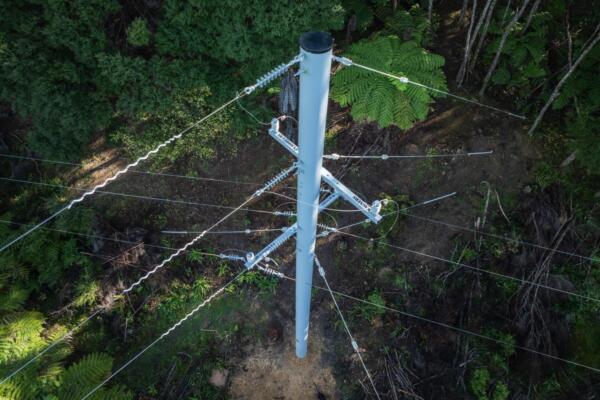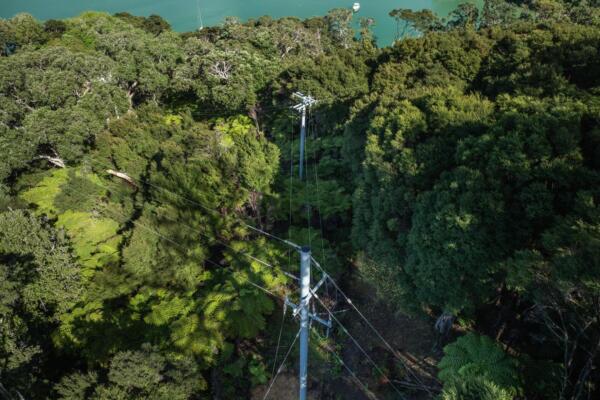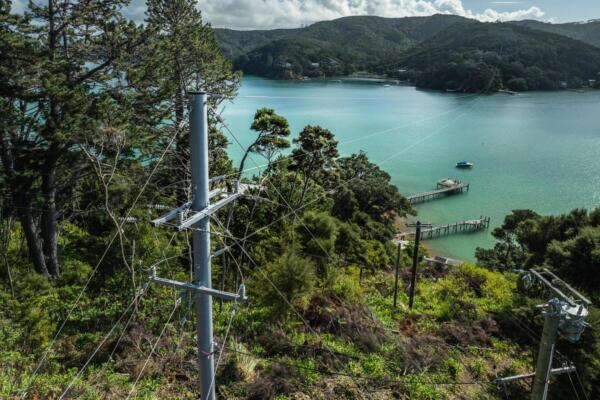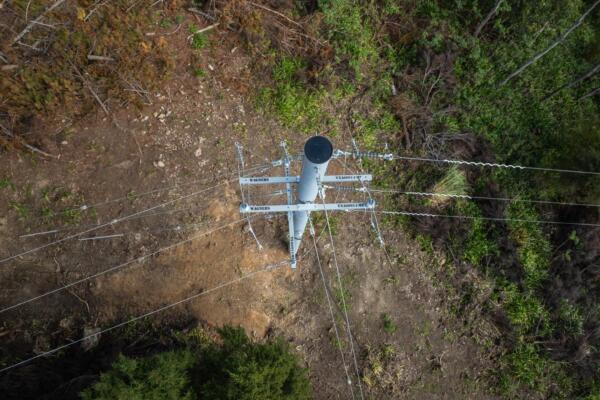
Not every electricity network challenge can be solved by simply installing more poles. Across Europe, the United Kingdom and Ireland, utilities are increasingly required to design overhead lines through environmentally sensitive landscapes, protected habitats, steep terrain, river crossings and remote locations where reducing the number of support structures can deliver significant environmental, planning and construction benefits. The Kawau Island project in New Zealand demonstrates how Fibre Reinforced Polymer (FRP) utility poles can support innovative long-span overhead line design when combined with rigorous engineering, validated structural performance and experienced network design. Rather than simply replacing traditional pole materials, the project highlights how composite infrastructure can expand the range of engineering solutions available to electricity network owners.
Demonstrating what is possible for long-span overhead line design
The challenge
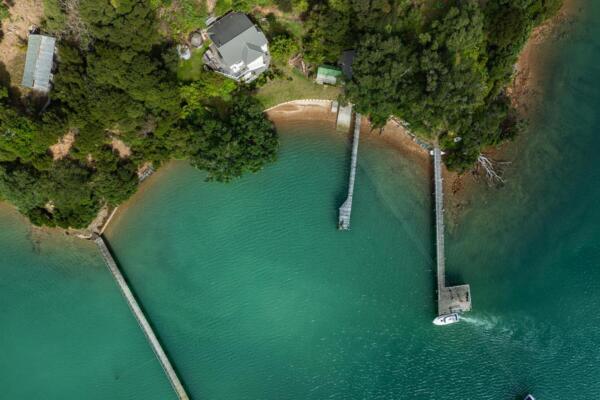
Supplying reliable electricity across Kawau Island required an overhead line solution capable of crossing a significant expanse of water while responding to the island’s difficult terrain and access constraints.
Vector independently designed and delivered the project using Wagners CFT FRP utility poles and composite crossarms. The design incorporated a single 746-metre span across the water which, to the best of our knowledge, represents the world’s longest individual span supported by an FRP utility pole.
For electricity network owners across Europe, the United Kingdom and Ireland, the project provides a practical example of how validated composite infrastructure can broaden the design options available for challenging water crossings, remote locations and environmentally sensitive landscapes.
Why long spans matter
For many European electricity networks, long-span capability can provide practical advantages beyond simply crossing difficult terrain.
Reducing the number of support structures can help:
- minimise environmental disturbance
- reduce foundation construction
- simplify access in remote locations
- cross rivers, valleys and protected landscapes
- reduce installation activity in sensitive environments
- support network resilience where access for future maintenance is limited
While every project requires its own engineering assessment, Kawau Island demonstrates the opportunities that become possible when lightweight composite infrastructure is combined with advanced structural design.
Proven engineering performance
Long-span overhead lines place significant demands on every component within the structure.
Rather than acting as an isolated pole, the complete system must safely transfer conductor loads through the crossarm, pole, stay system and foundations while maintaining serviceability throughout its design life.
The Kawau Island project utilised:
- 15 metre Wagners CFT FRP utility poles
- 2.4 metre FRP composite crossarms
- Three stay wires per structure
- A single 746-metre conductor span across an expanse of water
The project was supported by extensive structural testing undertaken by Wagners CFT, including validation of:
- Bending capacity
- Stiffness and deflection behaviour
- Bolt connection performance
- Local connection behaviour
- Washer pull-through performance
- Stay wire interaction
This engineering evidence provides designers with the confidence required to evaluate composite utility poles for demanding overhead line applications.
Why this project matters for Europe, the UK and Ireland
Electricity networks across Europe are facing many of the same challenges seen globally:
- ageing overhead line infrastructure
- increasing resilience requirements
- environmental and planning constraints
- difficult access locations
- pressure to reduce whole-of-life costs
- the need to decarbonise infrastructure investment
Projects such as Kawau Island demonstrate how FRP utility poles can support new approaches to network design by combining lightweight construction, corrosion resistance and predictable structural performance.
Rather than viewing composite poles as a direct replacement for traditional materials, many utilities are beginning to explore where their unique properties enable entirely different engineering solutions.
A project that expands engineering possibilities
Every network presents different technical challenges.
What Kawau Island demonstrates is that when manufacturers invest in testing, utilities embrace innovation and designers apply sound engineering principles, composite utility poles can support infrastructure solutions that would previously have been considered difficult or impractical.
For utilities across Europe, the United Kingdom and Ireland, it provides a compelling example of how validated composite infrastructure is helping expand what is possible in overhead line design.