
A blog by Global Utilities Lead, James Lorrimer
For more than a century, utility networks around the world have relied on a familiar material palette: wood, steel and concrete. These materials built the electrical networks that powered cities, connected communities and supported economic growth. But the challenges facing utilities today are not the same challenges networks were designed for 50 years ago.
Across Europe, the United Kingdom and Ireland, networks are under pressure from aging infrastructure, increasingly severe weather events, workforce shortages, environmental expectations, rising maintenance costs and the accelerating electrification of society.
At the same time, utilities are being asked to deliver more resilient, lower maintenance and longer-lasting infrastructure while reducing lifecycle costs and minimising disruption to customers.
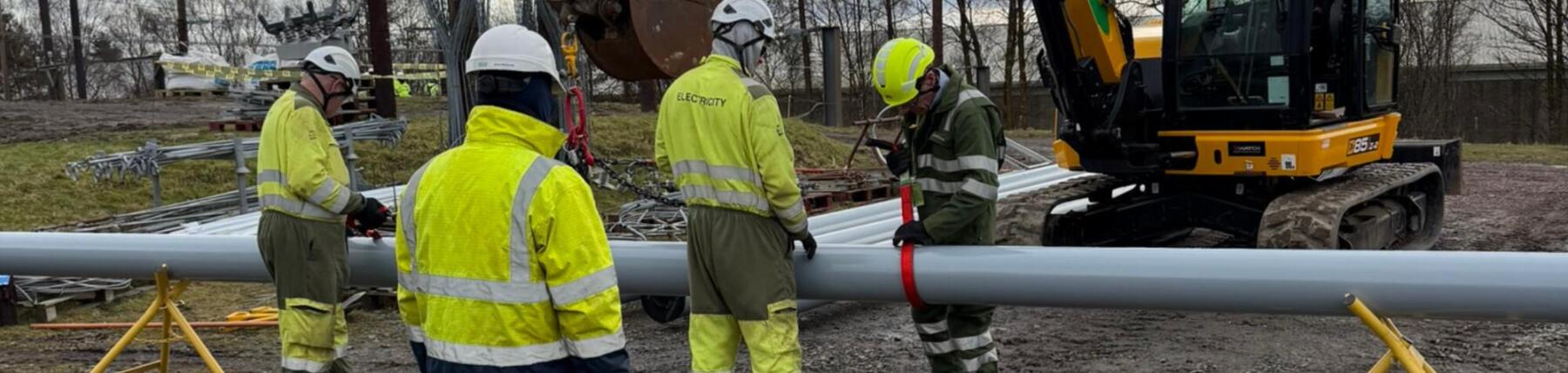
This is where Fibre Reinforced Polymer (FRP) utility poles are beginning to change the conversation.
What Are FRP Utility Poles?
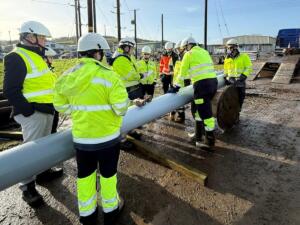
FRP utility poles, sometimes referred to as composite utility poles, are structural poles manufactured using advanced composite materials rather than traditional materials such as wood, steel or concrete.
While composites have existed for decades in aerospace, marine, automotive and industrial applications, their use in utility infrastructure has accelerated as networks search for materials that better suit modern operating environments.
Unlike traditional pole materials, FRP utility poles combine high strength with low weight, while also providing resistance to corrosion, rot, woodpeckers, salt exposure and environmental degradation.
Importantly, they are not simply designed to replace traditional poles. They are designed to solve problems that traditional materials increasingly struggle to address.
Why Are FRP Utility Poles Entering Europe, the UK and Ireland Now?
The arrival of FRP poles into Europe is not accidental. Several market forces are converging at the same time.
Aging Infrastructure Requires Replacement
Many networks across Europe and the UK were built decades ago. Large portions of utility infrastructure are reaching replacement age simultaneously, creating enormous capital replacement programs.
Utilities are increasingly asking whether replacing aging assets with like-for-like materials makes sense when newer technologies can reduce lifecycle costs and maintenance burdens.
Climate Resilience Has Become Critical
Extreme weather events are increasing in frequency and severity.
Storms, flooding, coastal exposure, bushfire risk in southern Europe, freeze-thaw cycles and high wind events are placing greater stress on networks.
Resilience is no longer viewed as a future requirement. It is an immediate operational need.
Workforce Constraints Are Increasing
Labour shortages continue to challenge utilities across multiple markets.
Infrastructure that is easier to transport, easier to install and requires less maintenance becomes increasingly valuable when skilled labour resources are limited.
Electrification Is Expanding Network Requirements
Electric vehicles, renewable energy connections, battery storage and distributed generation are driving major network upgrades.
Utilities require infrastructure solutions that can support expansion programs efficiently without creating additional operational complexity.
Are FRP Utility Poles Established Elsewhere?
One of the most common misconceptions is that FRP poles are an emerging or experimental technology.
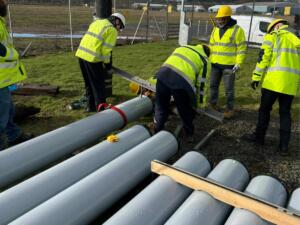
In reality, composite utility infrastructure has been deployed internationally for decades.
FRP poles and crossarms are already established across multiple regions globally including:
- North America, particularly in wildfire-prone, hurricane-exposed and coastal environments
- Australia and New Zealand, where utilities operate across harsh UV conditions, cyclonic regions, remote terrain and bushfire exposure
- Coastal regions where corrosion rapidly degrades traditional materials
- Remote and island networks where transportation and installation challenges significantly influence project costs
What has changed is not the technology itself.
What has changed is the scale of the challenges utilities face and the increasing recognition that infrastructure selection should be based on whole-of-life performance rather than upfront cost alone.
Where FRP Utility Poles Really Come Into Their Own
While FRP poles can be used across general distribution networks, there are environments where they deliver particularly strong value.
Coastal and High Corrosion Environments
Steel infrastructure can suffer significant corrosion in marine and coastal environments.
Wood can degrade over time through biological attack and moisture exposure.
FRP utility poles are naturally resistant to corrosion and do not rust, making them particularly attractive in coastal regions, salt spray zones and industrial environments.
Remote and Difficult Access Locations
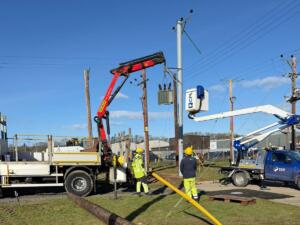
Weight matters.
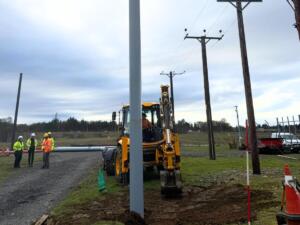
Composite poles are substantially lighter than many traditional alternatives.
This creates opportunities for:
- Reduced transportation requirements
- Smaller lifting equipment
- Easier handling on site
- Reduced installation complexity
- Improved access into difficult terrain
For mountainous regions, island networks, forestry environments and restricted access sites, lightweight infrastructure can fundamentally change project delivery methods.
Storm and Resilience Programs
Utilities increasingly prioritise resilience investment.
Composite poles provide utilities with additional options when designing infrastructure for regions exposed to high winds, flooding or severe weather events.
Reducing infrastructure vulnerability is becoming a key design objective rather than an afterthought.
Electrically Sensitive Environments
FRP materials are non-conductive.
This characteristic creates additional opportunities in applications where electrical performance and safety are important design considerations.
Areas Where Maintenance Access Is Difficult
Infrastructure located in remote environments, protected areas or difficult terrain often creates high maintenance costs.
Long-life, low-maintenance infrastructure can reduce operational interventions and improve asset management outcomes over time.
Beyond Performance: Why Lifecycle Thinking Matters
Historically, infrastructure selection has often focused heavily on upfront capital cost.
Today, utilities increasingly evaluate assets based on total lifecycle performance.
Questions are shifting from:
“How much does this asset cost to buy?”
Toward:
“How much will this asset cost to own, maintain, inspect and replace over the next several decades?”
Factors increasingly considered include:
- Installation costs
- Transportation requirements
- Inspection frequency
- Maintenance requirements
- Corrosion management
- Asset lifespan
- Network downtime risk
- End-of-life replacement cycles
This broader lifecycle view is one of the major drivers behind growing interest in composite infrastructure.
A Material for Modern Networks
The transition toward composite utility infrastructure is not about replacing every existing pole material.
Every material continues to have applications.
Instead, FRP utility poles provide utilities with another tool available to solve increasingly complex infrastructure challenges.
As networks evolve, material selection is becoming less about tradition and more about performance in specific operating environments.
The question utilities are increasingly asking is not:
“Why composites?”
The question is:
“Where do composites deliver the greatest value?”
For many networks across Europe, the UK and Ireland, that answer is becoming clearer.
FRP Utility Poles Are Now Available Across Europe, the UK and Ireland
As utilities across Europe, the United Kingdom and Ireland look toward more resilient, lower maintenance and future-ready infrastructure, access to proven composite solutions is becoming increasingly important.
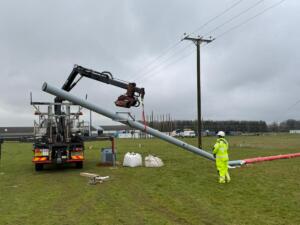
Wagners CFT is now bringing its FRP utility pole solutions to these markets, supporting utilities with infrastructure designed for demanding operating environments and long-term asset performance.
Whether you are exploring alternatives for coastal environments, remote installations, resilience programs or network upgrades, composite infrastructure is now part of the conversation.
The future network will not simply be stronger.
It will be smarter about the materials it chooses.

